The World Bank says frequent increases to the tax‑free threshold have weakened income tax revenues at a time revenues have remained far below the level needed to fund public services.
Published World Bank data show that in 2019, the threshold rose from K35 000 to K45 000, 28 percent above the minimum wage while in 2020, it jumped by 120 percent to K100 000 while the 15 percent middle tax bracket was eliminated, narrowing the tax base.
Over the past five years, tax revenue has averaged 13.8 percent of gross domestic product (GDP), below both the 15 percent benchmark and the Domestic Revenue Mobilisation Strategy target of 17 percent.
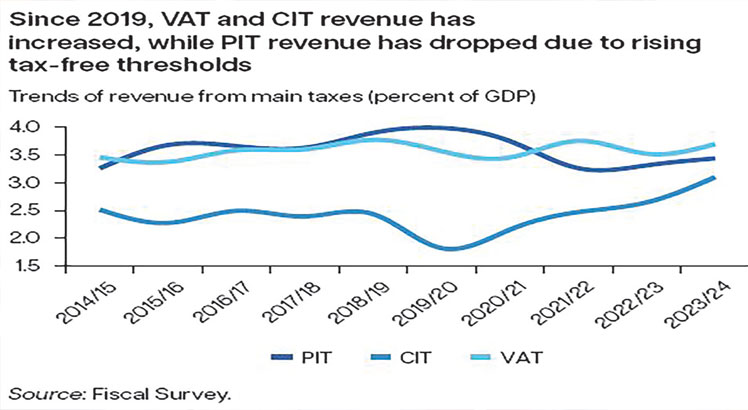
In its analysis of domestic revenue mobilisation, the World Bank observed that while tax‑free threshold adjustments align with the strategy goals of inflation indexing and progressivity, they were not offset by revenue‑enhancing reforms, thereby slowing revenue growth and undermining long‑term sustainability.
Ironically, Malawi’s Pay As You Earn (Paye) system offers one of Africa’s most generous tax‑free thresholds relative to GDP per capita, according to the World Bank.
To address this, the bank said expansion of revenue sources such as reducing value added tax (VAT) exemptions is essential because once revenue stabilises, automatic inflation adjustment would improve system consistency.
Reads the analysis in part: “To address this, expanding revenue is essential. Once revenue stabilises, automatic inflation adjustment of personal income tax thresholds would improve system consistency.
“Malawi’s Paye system reflects a strong commitment to protecting low‑income earners,.”
According to the bank, when adjusted for GDP per capita at purchasing power parity (PPP), the zero‑income tax bracket set at $3 139 (about K5.4 million) annually is high, shielding a substantial portion of income from taxation.
Malawi shares this feature with countries such as Zambia ($9 277), Uganda ($2 323), Madagascar ($3 416), Central African Republic ($1 583) and Burundi ($2 487), where PPP‑adjusted tax‑free bands exceed GDP per capita.
In contrast, countries such as Zimbabwe ($300), Rwanda ($174) and Ethiopia ($325) have tax‑free bands below GDP per capita, resulting in a larger share of personal income being taxed.
World Bank observes that around 90 percent of personal income tax revenue comes from Paye on formal wages, placing a disproportionate burden on middle‑income earners, while wealthier individuals, especially those earning from business ownership, real estate and investments, remain largely untaxed.
Under the new tax regime, the zero Paye bracket has increased from K150 000 to K170 000.
Those earning between K170 000 and K1.57 million will now be taxed at 30 percent, up from 25 percent.
Earners of up to K10 million will be taxed at 35 percent while those earning beyond K10 million will face a 40 percent tax.
In an interview on Tuesday, economist Bond Mtembezeka said there is need to align the tax free band to the cost of living realities on the ground.
He said: “At K170 000, our present tax-free band is way lower than the average cost of living of around K800 000 going by statistics produced by the Centre for Social Concern.
“The cost of living has outpaced the tax-free bands over the years and people’s livelihoods have consequently not been made any better.”
In its analysis of the 2025/26 Mid-Year Budget Review, Economics Association of Malawi observed that the higher Paye rates for middle and high-income earners could help cover part of the deficit and potentially increase total Paye collections.